
There's a Reason Why You Think People Don’t Like You
2 Simple Changes to Improve Your Ability to Make Better Connections and Friends


Guests are milling about the island in my kitchen – drinks in hand, enjoying a little charcuterie and lively conversation. From behind me, I overhear a political comment from a guest with a booming voice that cannot be missed.
I freeze, thinking, holy cow this cannot be good.
I can feel the pause in conversation behind me, but I cannot hear the exchange above the music.
A week later, two of the guests filled me in. One said, “OMG, I think I said too much.” The other said, “I feel like I was so rude to him.” Both figured there was no way they made a new friend that evening. They were embarrassed and contrite.
Understandably, the cringe-worthiness of the experience made them want to duck and hide.
Been there.
Done that.
Insert foot into mouth.
Hope you haven’t offended other party guests or your host.
And pray for mercy.
The “Liking Gap”
#1: Suspend the disbelief of your unlike-ability.
Change your perception of yourself and the result will change.
When I asked the political-bomb-lighter about the exchange, he laughed. He hadn’t given it a second thought other than, those people are really interesting and fun. I kid you not!
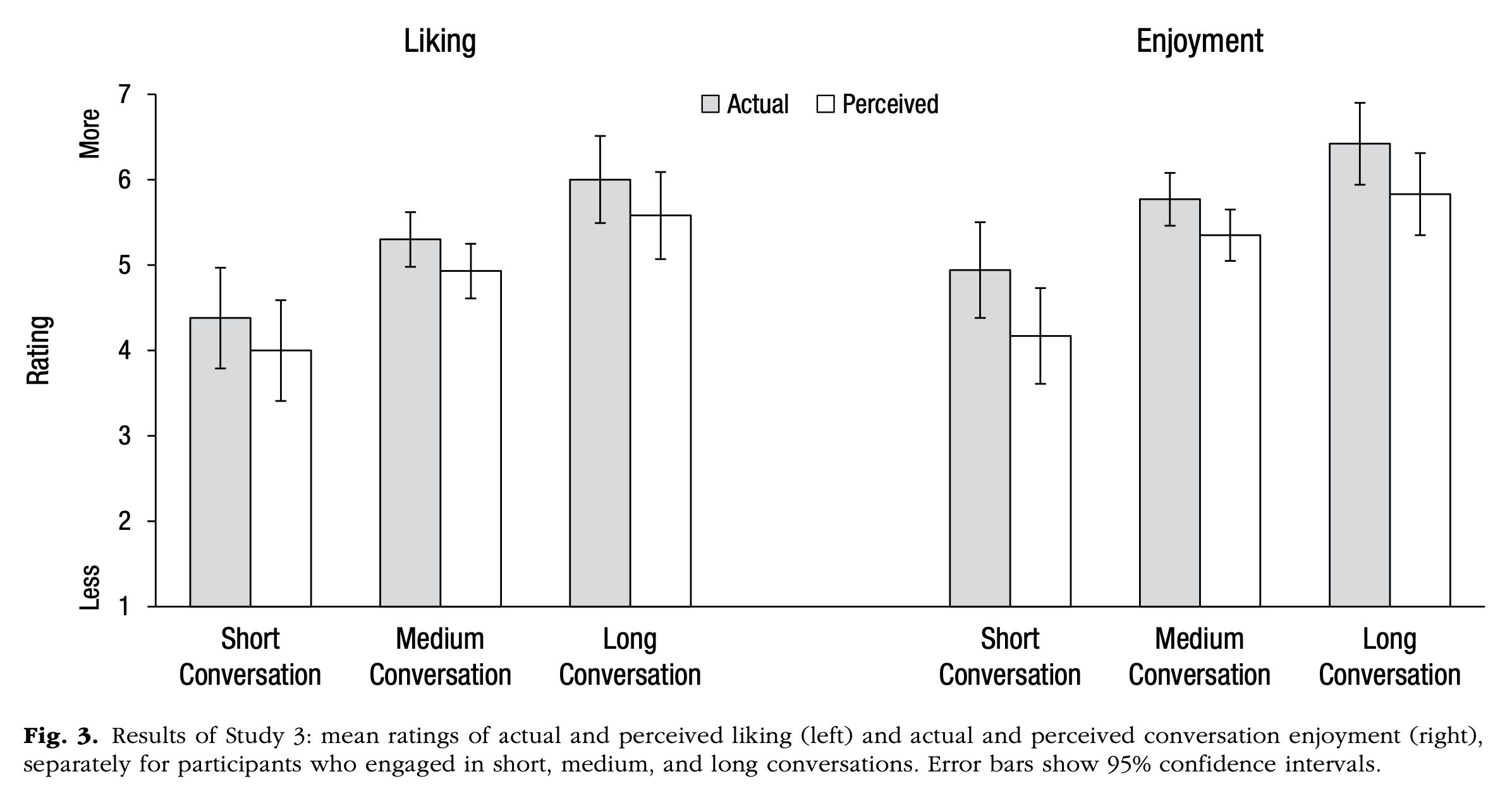
One of the biggest hurdles we face when trying to connect with others and forming new friendships is getting past these types of misconceptions. The combined research from Yale, Harvard, and Cornell University defines a concept called the “Liking Gap” as “the disparity between how much a person believes that another person likes them and that other person's actual opinion” – specifically when engaging in conversation.
In other words, what it boils down to is this.
Your own self-criticism/doubt
Assumptions about the conversation and what they thought
Underestimating how much they liked you or enjoyed the conversation
When in fact, the experience is often different than you may realize. Below is a chart from the research team showing that the perception of liking is higher than perceived.
Conversation length isn’t even a factor. The result is the same.
A Flawed Attempt
#2: Shift Your Focus:
Conversation is what creates relationships.
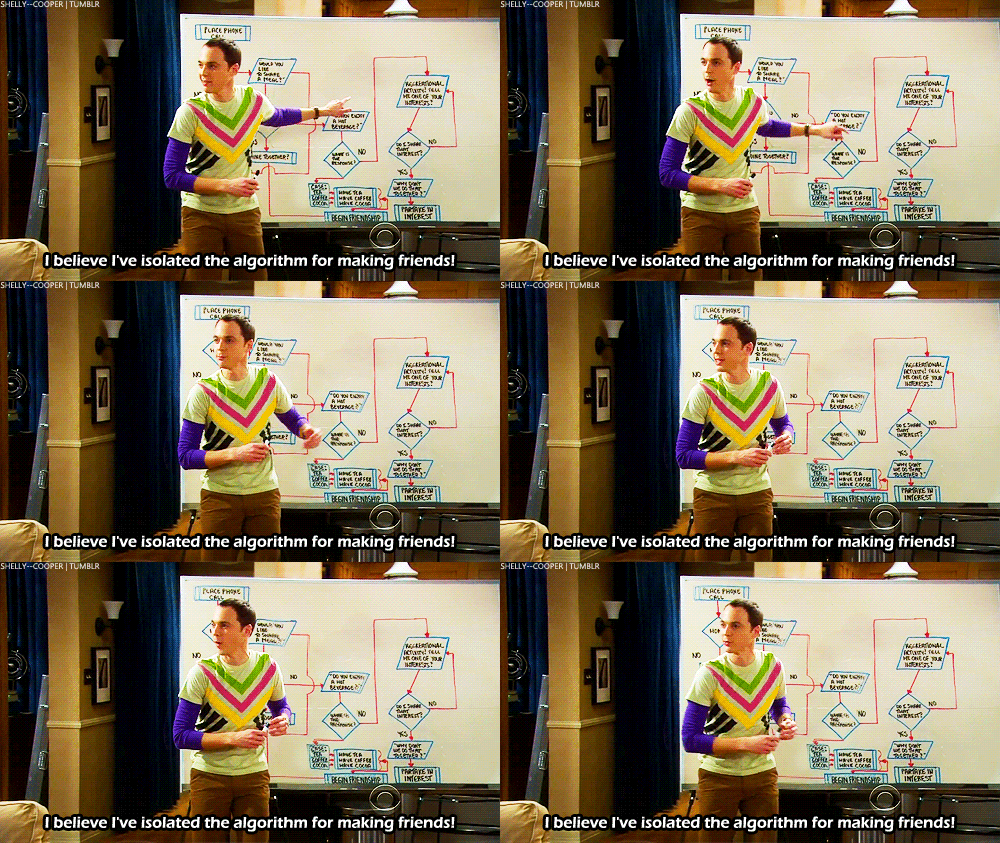
Dr. Sheldon Cooper, the lead character in the sitcom Big Bang Theory, decides that he wants to make new friends but has no idea how to make it happen – except to research to find an answer. Gleaning his direction from children’s books, he creates a process diagram with several “trap doors” and possible “escapes” when objections arise from a potential new friend to his suggestions to meet for a beverage or activity.
Sadly, he fails miserably.
As many of us do.
When we can get past the initial politeness, and fear of rejection, and invest in the cognitive brainpower it takes to have a meaningful conversation, we can find that connection, common ground, and new friendships. But it takes time.
Average Time to Create Friendships as an Adult is longer than we think
Casual friends - 90+ hours
Meaningful friends - 160+ hours
It’s an investment worth making both personally and professionally.
Am I Being Too Needy?

This “Liking Gap” can be subtle, yet it appears in everyday engagement.
Recently I made a wonderful new friend. We have a lot in common, but also many differences. Our conversations open up rapidly. I’m fascinated by her life’s journey and her perspective on things.
When I hadn’t heard from her for a few days, I asked what had happened. Sheepishly, she said “Well, I didn’t want to appear needy.” I smiled and put my hand on her arm. “You are not being needy.” We both laughed.
Whether you’ve invested less than 90 hours, more than 90 hours, or over 160 hours, we are liked far more than we give ourselves credit.
Think about that the next time you are in a conversation with someone.
_________________
Paradoxically, freeing yourself from the need to be liked is one of the best ways to be likeable.
Disrupting your listening to continually make points or references to why you should be likeable stops you from engaging and building the relationship.
This makes so much sense. The Liking Gap, that we misread the cues, and that friendships take time.
I find if we approach anyone with an open heart, sure we can get slammed sometimes, but more likely it's seen as refreshing and opens doors.